
Charts of the Week
Charts of the week from 12 to 16 October 2026: persons in employment, activity in construction, current account of the balance of payments and other charts
In August, the number of persons in employment remained similar to both July and a year earlier. Year-on-year employment growth was recorded mainly in public service activities and in professional, scientific and technical activities in the private sector, while some of the more labour-intensive private sector activities recorded the largest declines. Following considerable fluctuations in previous months, construction activity declined sharply in August and was only 4% higher year-on-year. The current account surplus of the balance of payments was lower in the twelve months to August than in the corresponding preceding twelve-month period, mainly due to a larger goods trade deficit. Road and rail freight transport remained virtually unchanged in the second quarter compared with the previous quarter. Electricity consumption was higher again year-on-year in September.
Persons in employment, August 2026

The number of persons in employment was again similar to a year earlier in August, although developments continued to vary considerably across sectors. In the private sector, employment declined year-on-year particularly in labour-intensive activities, especially trade (–1.4%) and manufacturing (–1.1%), with the decline in the latter gradually moderating in recent months. Employment increased particularly in professional, scientific and technical activities (0.8%). In public service activities, the number of persons in employment continued to increase, most notably in human health and social work activities (3.4%). The total number of persons in employment continues to be supported mainly by growth in the employment of foreign nationals (3.4% year-on-year), which has gradually strengthened since the beginning of the year, while the number of Slovenian nationals in employment continues to decline (–0.6%). Labour shortages remain one of the main constraints on business activity, particularly in construction and service activities.
Activity in construction, August 2026
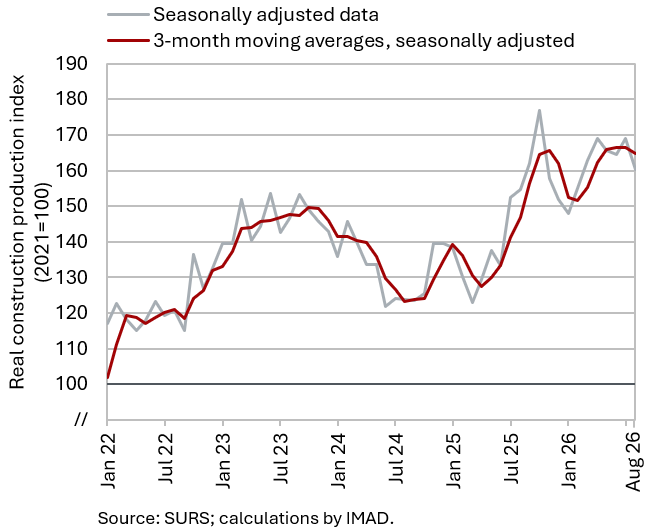
The value of construction work declined sharply in August and, against a high base in the same month last year, was only 4% higher year-on-year, while growth in construction services prices remained high. Following strong growth at the beginning of this year, the value of construction work fluctuated considerably around the middle of the year, declining sharply in August (by 5% month-on-month). At the same time, owing to the strong acceleration in construction activity in the second half of last year, year-on-year growth was considerably lower in August. While the value of construction work was 23% higher year-on-year in the first half of the year, it was only 4% higher in August.
Construction prices have risen considerably year-on-year this year. The implicit deflator of the value of construction work (which measures construction prices) stood at 6.6% in August, while the value added deflator in construction rose to 7.2% in the second quarter (more recent data are not yet available). The high level of the value added deflator suggests that prices of construction services are rising faster than input costs, or that profit margins in the construction sector are increasing amid strong demand.
Current account of the balance of payments, August 2026

The 12-month current account surplus (up to August) amounted to EUR 2.7 billion (3.6% of estimated GDP), EUR 484.1 million less than in the preceding 12-month period. The largest contribution to this change came from a larger annual goods trade deficit, mainly due to a smaller surplus in trade with non-EU countries. According to IMAD estimates, volume developments contributed EUR 577 million to the deterioration in the trade balance (EUR 917 million), while changes in the terms of trade accounted for EUR 340 million. The secondary income deficit also widened, primarily due to higher contributions to the EU budget based on gross national income and value added tax. The services surplus increased, particularly due to a higher surplus in insurance services, reflecting the expansion of a Slovenian insurance company’s operations and related services in the Italian motor insurance market. The surplus in transport services also increased. The primary income deficit narrowed, mainly due to smaller net outflows of income from equity (dividends and profits) and partly due to higher income earned by Slovenians working abroad.
Electricity consumption by consumer group, September 2026

Electricity consumption in the distribution network was 3.8% higher year-on-year in September. Among the main consumer groups, industrial electricity consumption increased by 4.2%, consumption by other business users by 3.3%, and household electricity consumption by 3.6%.
Road and rail freight transport, Q2 2026

In the second quarter of 2026, the volume of road and rail freight transport, which has generally been declining since 2022, remained largely unchanged quarter-on-quarter. In road transport performed by Slovenian vehicles, the volume of cross-trade declined further (by 3%) and remained further below its 2019 level than transport taking place at least partly on Slovenian territory (exports, imports and national transport). The latter increased by 4% quarter-on-quarter. The share of cross-trade in total transport remained at 43%, below its pre-pandemic level (50% in the second quarter of 2019). In contrast to road freight transport, rail freight transport on Slovenian territory was considerably higher year-on-year (by 8%, compared with a 3% decline in road transport), owing to strong growth in the first quarter. Nevertheless, it remained significantly below its level in the corresponding period of 2019 (by one-tenth).