
Charts of the Week
Charts of the week from 29 June to 3 July 2026: consumer prices, exports and imports of goods, turnover in trade and other charts
Year-on-year inflation remained at 3.6% in June. Energy prices again made the largest contribution to inflation, while the contribution of services prices increased markedly following a month-on-month rise in package holiday prices. Goods exports and imports declined month-on-month in May, mainly owing to lower trade in petroleum products, which has exhibited considerable monthly volatility in connection with the conflict in the Middle East. In the first five months, both goods exports and imports were higher year-on-year. Real turnover in the trade sectors continued to increase in April, while real turnover in market services decreased slightly. In the first four months, both were higher than in the same period last year. The yield to maturity on the Slovenian government bond increased in the second quarter, while the spread over the German government bond widened slightly.
Consumer prices, June 2026

Year-on-year consumer price inflation remained unchanged in June (3.6%), while prices increased by 0.8% month-on-month. Monthly inflation was driven primarily by stronger seasonal factors, notably a 16.7% increase in package holiday prices, which was almost twice as high as in June last year. This also contributed to a marked acceleration in year-on-year services inflation, which reached 5%, its highest level since March 2024, contributing 1.7 p.p. to overall year-on-year inflation. In addition to services prices, the groups affected by energy prices (housing, water, electricity, gas and other fuels; and transport) continued to make a significant contribution (2.0 p.p.) to year-on-year inflation. The contribution of other goods to year-on-year inflation remained modest. Year-on-year price growth in the food and non-alcoholic beverages group continued to moderate, falling to 0.5%, the lowest rate in the past two years. Prices of semi-durable goods (–0.2%) and durable goods (–0.8%) were lower than a year earlier.
Exports and imports of goods, May 2026

Both exports and imports of goods decreased month-on-month in May, and their volume remained higher than a year earlier. Recent developments in goods trade have been shaped primarily by uncertainty in the international environment and significant fluctuations in trade in petroleum products. Following growth in recent months, total real exports of goods declined in May compared with the previous month (–3.7%, seasonally adjusted). After increasing in April, both the volume (real) and the value of petroleum product exports decreased markedly. The decline in May was also driven by lower exports of machinery and equipment group (particularly industrial machinery, electrical machinery and equipment, and to a lesser extent road vehicles), which accounts for around one-third of total goods exports. By contrast, exports of pharmaceutical products, other chemical products, and metals and metal products further increased. Imports declined compared with the previous month for the second consecutive month (– 7.0%, seasonally adjusted), driven to a significant extent by lower imports of petroleum products in both volume and value terms. Among the other main product groups, only imports of consumer goods declined slightly, although these have exhibited pronounced fluctuations in recent months (all seasonally adjusted). In the first five months of this year, real exports were 3.9% higher year-on-year, whereas imports were 6.2% higher. The increase in exports was driven primarily by exports of pharmaceutical products, motor vehicles, metals and metal products and electrical machinery and equipment, while import growth was mainly attributable to the machinery and equipment group as a whole (including motor vehicles), as well as metals and metal products.
Amid persistently high uncertainty in the international economic environment, export orders remained relatively weak in June.
Turnover in trade, April 2026

Real turnover in most trade sectors continued to increase in April and was also higher year-on-year. Turnover in the sale of motor vehicles increased for the third consecutive month, following the decline recorded around the turn of the year. Retail sales of food, beverages and tobacco products and of non-food products increased for the second consecutive month in April. After a marked increase in March, wholesale turnover declined slightly but remained well above its level at the end of last year (all seasonally adjusted).
In April, and cumulatively over the first four months of the year, sales in all trade sectors, except retail trade in food, beverages and tobacco, was higher than a year earlier. In the first four months, sales in motor vehicle trade were 5% higher than in the same period last year, while sales in wholesale trade and retail trade in non-food products increased by 3% in each sector.
Turnover in market services, April 2026

Total real turnover in market services declined in April following growth in the first quarter (seasonally adjusted), but remained higher than a year earlier. In professional, scientific and technical activities, turnover declined slightly for the second consecutive month in April after strong growth at the beginning of the year. In month-on-month terms, turnover is particularly volatile in architectural and engineering activities. Turnover also declined further in information and communication, where it had generally been strengthening since the second half of last year. It also decreased slightly in transportation and storage, although it has broadly stagnated since the end of 2024. In accommodation and food service activities, turnover has continued to increase at a moderate pace this year, following stronger growth at the end of last year, albeit with monthly fluctuations. In administrative and support service activities, turnover has been gradually increasing since the beginning of last year, including in April (all seasonally adjusted), but remained slightly below its 2019 average. In the first four months of the year, total real turnover was 5.1% higher year-on-year, with the strongest increase recorded in professional, scientific and technical activities.
Bond, Q2 2026
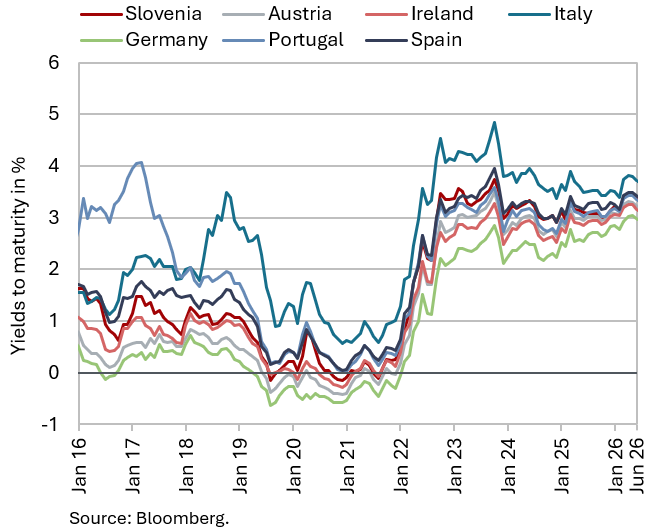
In the second quarter of this year, the yield to maturity of the Slovenian government bond increased by 17 basis points, to 3.42%. Government bond yields also increased in other euro area countries. For most of the second quarter, yields remained relatively stable, fluctuating around the levels reached at the end of March. In mid-June, following the signing of an agreement between Iran and the United States, yields declined amid lower oil prices and expectations of weaker inflationary pressures. The spread between Slovenian and German government bond yields widened slightly compared with the first quarter, increasing by 2 basis points to 41 basis points.